San Francisco 1906: The Earthquake Was Only the Beginning
How can a devastating earthquake last less than a minute, yet leave a city burning for three days? The answer survives in extraordinary motion-picture film, historic photographs, and the science of the San Andreas Fault.
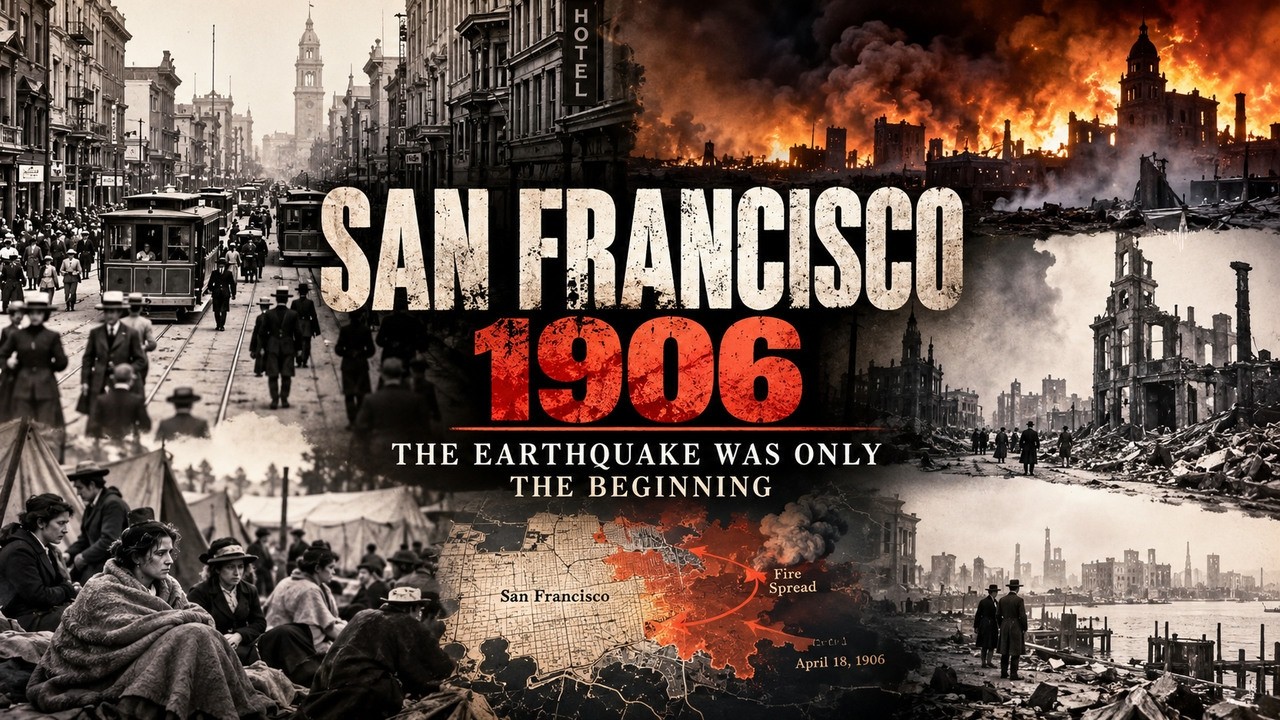
A City Just Four Days Before Disaster
On April 14, 1906, a camera moved along San Francisco's Market Street. Its view captured the tempo of daily life: electric streetcars, horse-drawn wagons, cars, pedestrians, shopfronts, and a street busy with ordinary decisions. The Miles Brothers filmed the journey from a moving cable car. It is remarkable evidence not because it shows a disaster, but because it does not.
The film negative was sent away from San Francisco on April 17, one day before the earthquake. That decision helped preserve the record of a street whose appearance would be transformed. Today, the Library of Congress preserves the film as part of its public-domain collection documenting San Francisco before and after the great earthquake and fire.
There is an important distinction here: this motion picture was filmed before the earthquake. It is not footage of the city shaking. Other films of the destruction were made afterward, in some cases days or weeks later. Their historical context matters just as much as their striking images.
April 18, 1906: The Ground Moved
At approximately 5:12 a.m. on April 18, a powerful earthquake struck the San Francisco region. The United States Geological Survey describes a magnitude of approximately 7.8, more than 40 seconds of strong shaking, and a long rupture along the San Andreas Fault. The earthquake was felt far beyond the city.
That rupture carried violent movement into foundations, walls, streets, and buried infrastructure. Many buildings were not designed to tolerate significant sideways motion. Cracked masonry, fallen chimneys, collapsing walls, and damaged utilities transformed the urban landscape within seconds.
But even as people escaped unstable buildings, a second and longer emergency was beginning.
Why the Fires Became So Devastating
The fires that followed the earthquake were not simply an unavoidable consequence of one burning building. A combination of factors made the disaster exceptionally difficult to contain. Damaged gas infrastructure helped start fires. Essential water pipelines were damaged, while a densely built city supplied paths for flames to spread through adjacent structures.
Firefighters faced the immense challenge of fighting multiple fires without dependable water pressure everywhere they needed it. Broken roads and damaged buildings complicated movement. A short seismic event had triggered a prolonged emergency, and a series of failures made each next problem harder to solve.
Historic photographs show smoke, charred streets, and ruined buildings. Modern maps and carefully labeled explanatory graphics can help trace the sequence of the earthquake and fire, but those graphics are illustrations, not primary evidence from 1906.
Watch the Documentary: Original 1906 Footage and Modern Historical Analysis
The documentary brings together the original moving Market Street film, public-domain aftermath footage, historical photographs, and diagrams that explain what cameras could not directly record. The distinction between archive and reconstruction is central to the film.
What the Cameras Showed Afterwards
In the weeks after April 18, motion-picture cameras documented damaged streets, ruined buildings, and landscapes changed beyond recognition. The Library of Congress holds the historic film San Francisco Earthquake and Fire, April 18, 1906, described as a record of the aftermath. Some of its intertitles were sensational, and its catalog notes that at least one scene may have been staged.
That does not make the archive worthless. It makes careful interpretation essential. A viewer should be told whether a scene was filmed before the disaster, after it, or created today as an illustration. We should not use an old photograph of soldiers to claim it proves a ruptured water main, and we should not present a digitally invented fire as camera footage from the original tragedy.
Authentic photographs by Arnold Genthe and other photographers reveal smaller details that wide panoramas can miss: damaged streets, abandoned structures, and people making sense of the surroundings. The most meaningful historical interpretation often emerges from how those different sources agree and where their limits remain.
The People Behind the Numbers
According to the USGS historical report, at least 3,000 people lost their lives and around 225,000 were left homeless. Those estimates describe an enormous human emergency, not merely a destroyed collection of buildings.
Residents needed shelter, food, access to water, and information about family members. Surviving archive photographs document refugee camps and people cooking outdoors. The National Archives and the Library of Congress hold photographs that can help show this part of the story without inventing the identities or experiences of individual survivors.
The aftermath was not confined to the obvious flames in the photographs. It was also the quieter question of where thousands of people could go next.
What San Francisco Taught Later Generations
The 1906 earthquake had lasting importance for the scientific study of faults and for thinking about resilient buildings and infrastructure. Its story connects ground rupture to consequences that persist after the shaking stops: damaged water systems, fires, disrupted transport, and a need for emergency shelter.
The disaster cannot be reduced to a single lesson or a promise that today's cities are invulnerable. Instead, its historical record encourages practical questions. What happens when vital services fail at the same time? Which structures are most vulnerable? How can better information and planning reduce harm?
Why the Old Film Still Matters
A trip along Market Street in April 1906 was originally just a record of everyday traffic. More than a century later, it is a moving view of a world about to change. On its own, the film cannot explain the fault, the fire, or the city's recovery. Combined with dated photographs and reliable historical research, it offers a rare perspective on what was lost.
The San Francisco earthquake was only the beginning of the emergency. The surviving archive gives us a way to understand the days that followed, and a reminder that historical authenticity is more valuable than a spectacular reconstruction that never happened.
Primary Sources and Visual Credits
- Library of Congress: A Trip Down Market Street Before the Fire (filmed April 14, 1906).
- Library of Congress: San Francisco Earthquake and Fire (historic aftermath film).
- LOC: Before and After the Great Earthquake and Fire Collection.
- USGS: Facing the Great Disaster, 1906 San Francisco Earthquake.
- Library of Congress: Arnold Genthe, San Francisco, California, 1906 photo collection.
- LOC: Refugees at Golden Gate, 1906.
- USGS: 1906 historical ShakeMap.
Editorial note: The film distinguishes original 1906 footage from later photographs, modern graphics, and any clearly labeled illustrative reconstruction. All final images and media will have individual source and rights verification before the article is published.
